Thursday, April 11, 2013

Here is the draft of my small scale test to determine cable tension based on Taut String Theory using a contact sensor. (original graphic) 

***Note for more accurate readings the tri-axial accelerometer should be located more towards the center of the cable.

Tuesday, April 9, 2013

Research Abstract


How can tension in cables of pre-existing tensile roof structures be measured?
Matt Walker
April 9, 2013
Introduction:
Tensile roof structures are becoming more common for large public spaces such as conventions centers, transportation hubs and sports arenas. The reason for their popularity is impressive and pleasing appearance.  Extensive calculations are done by structural engineers at the planning stage to determine forces that will act on the completed structure. From this information it is possible to determine the theoretical loads that will act on the supporting cables and model them accordingly.   During and after the construction phase there are many factors that may cause variations between the calculated tensile loads and the actual values.  Some of these factors may include weather abnormalities, geotechnical shifts, improper construction, fire and intentional tampering. Under any of these circumstances it is important to know what the actual tension is in these cables to determine the safety of the structure.  There is no well-established procedure for determining this information.
Abstract:
This thesis discusses the possibility of using the taut string theory to determine in-situ conditions found in the cables of tensile roof structures and proposes a simple procedure for finding these values. “Currently available techniques to estimate the cable tension include the static methods directly measuring the tension by a load cell or a hydraulic jack, and the vibration methods indirectly estimating the tension from measured natural frequencies. In practice, the vibration methods have received increasing attention because of its simplicity and speediness.”  (Estimation of cable tension force using the frequency-based system identification method, 2006, pg.1) The focus of this study will be on vibration methods and the various measuring devices that can be used to determine tensile loads in cables.
The types of instrumentation used to measure vibration in cables are tri-axial accelerometers (contact sensors), microwave interferometry, “The microwave interferometry has recently emerged as an innovative technology, suitable to the non-contact vibration monitoring of large structures.”(Deflection measurement on vibrating stay cables by non-contact microwave interferometer, 2009, pg. 1) and laser Doppler vibrometers, “the LDV measurements of deflection and velocity compare very well with those recorded by the contact sensors and may be used as an alternative to the two systems.” (Comparison of laser Doppler vibrometer with contact sensors for monitoring bridge deflection and vibration, 2004, pg. 1)

To perform the actual tests rope access technicians (industrial climbers) will climb fixed static ropes to access the cables. Once in position the technician will strike the cable with a hammer and a reverberation will commence. During the time of the vibration, measurements will be taken with one of the above measuring instruments. It is crucial that the technician is not attached to the cable at the time of vibrations as this will skew the results.

The reasons for choosing the use of rope access technicians as opposed to boom lifts or scaffolds as means of access is a matter of time and cost. It is simply more efficient to have a two man team conduct tests in a day without interruption to facility operations than to close the building to move in a boom lift or to erect a system of scaffolds.

The chosen instrument to measure vibrations will be a tri-axial accelerometer that will be fixed to the cable with quick set epoxy. The decision to use this device has been made because of the durability and compact nature of the device. Although the other devices may produce a more accurate and precise reading their applications are impractical due to the fact that the majority of tensile roof cables are at higher elevations, in horizontal configurations and may be enclosed in an insulating liner. This would make it impractical to use the latter two because it would be difficult to get a clear shot of the cables from the ground and may run the risk of damage to expensive measuring devices. It is also more efficient to have two technicians perform the entire test in place than to have an additional ground man operating the measuring instruments.

From the collected data it will be possible determine the approximate tension found in the cables by application of the taut string theory and comparing the results to the predetermined safe working loads determined by the structural engineer.

References cited:

Byeong Hwa Kima, Taehyo Parkb. (2006) Estimation of cable tension force using the frequency-based system identification method. Retrieved April 9, 2013 from http://dx.doi.org/10.1016/j.jsv.2007.03.012

Carmelo Gentile. (2009) Deflection measurement on vibrating stay cables by non-contact microwave interferometer. Retrieved April 9, 2013 from http://dx.doi.org/10.1016/j.ndteint.2009.11.007

Hani H. Nassif, Mayrai Gindy, Joe Davis. (2004) Comparison of laser Doppler vibrometer with contact sensors for monitoring bridge deflection and vibration. Retrieved April 9, 2013 from http://dx.doi.org/10.1016/j.ndteint.2004.06.012


Borri, C., Majowieki, M., & Spinelli, P. (1992). Wind response of large tensile structure – The new roof of the Olympic Stadium in Rome. Journal of Wind Engineering and Industrial Aerodynamics, 42(1-3), 1435-1446.

Bridgens, B., & Birchall, M. (2012). Form and function: The significance of material properties in the design of tensile fabric structures. Engineering Structures, 44, 1-12. doi: 10.1016/j.engstruct.2012.05.044

Eisenloffel, K., & Adeli, H.(1993). Microcomputer-aided design of tensile roof stuctures. Computers & Structures, 46(1), 157-174.

Rizzo, F., D’Asdia, P., Lazzari, M., & Procino, L. (2011). Wind action evaluation on tension roofs of hyperbolic paraboloid shape. Engineering Structures, 33(2), 445-461. doi: 10.1016/j.engstruct.2010.11.001

Rizzo, F., D'Asdia, P., Ricciardelli, F., & Bartoli, G. (2012). Characterisation of pressure coefficients on hyperbolic paraboloid roofs. Journal of Wind Engineering & Industrial Aerodynamics, 102, 61-71. doi: 10.1016/j.jweia.2012.01.003

Szostkiewicz-Chatain, C., & Hamelin, P. (1998). Numerical and experimental stiffness characterisations applied to soft textile composites for tensile structures. Materials and Structures, 31(2), 118-125. doi: 10.1007/BF02486474

Anonymous. (2008). Berlin central station, Germany. The Architectural Review, , 39.

Szostkiewicz-Chatain, C., & Hamelin, P. (1998). Numerical and experimental stiffness characterisations applied to soft textile composites for tensile structures. Materials and Structures, 31(206), 118-125.

Wakefield, D. (2006). Tensile structure design an engineer's perspective. Architectural Design, 76(6), 92-95. doi: 10.1002/ad.370


                                                             Laser Doppler vibrometer
(Comparison of laser Doppler vibrometer with contact sensors for monitoring bridge deflection and vibration, 2004, fig. 2)


                                                             Microwave interferometer
 (Deflection measurement on vibrating stay cables by non-contact microwave interferometer, 2009, fig. 1)


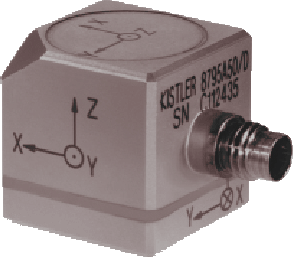
                                                             Tri-axial accelerometer
                                      (http://www.intertechnology.com/Kistler/images/8795A.gif)

Thursday, April 4, 2013


Here is an example of a typical cross section through a tensile roof structure. Pay particular attention to the ridge and valley cables as this is the focus of my research. This is a original image created by Matt Walker, base image courtesy of  Denardis Engineering.


Tuesday, April 2, 2013

Forward


It has come to my attention that some of you might not fully comprehend my proposed research.  I am having difficulties identifying how I can present this topic with more clarity. It would be appreciated if you could offer some insight…
Currently I am working on a revised version of my proposal. I will try to use less technical terminology but there is only so far I can go while still remaining professional.  It has occurred to me that a lot of you do not know what rope access is. Below I have included links giving brief descriptions of this specialized trade.

Rope access (ask.com)

Rope access techniques (youtube.com)

After reading these articles and watching the video I hope that you have a better understanding of this profession and how it will be used to carry out the on-site portion of my research. 

Friday, February 8, 2013

Research Proposal


Measurement of tensile loads

 of cables

 in tensile roof structures


Matt Walker

February 6, 2013


 Summary statement of proposed project:

The proposed research is to provide scientific data to measure and quantify tensile forces in the cables using vibration technique.

Purpose:

The purpose of this research is to provide test data from vibration tests that could be used by industry to determine in-situ tensile forces in cable for tensile roof structures. The importance of knowing this is crucial in determining the safety of the structure and its durability. 

Goals and objectives:

The end results of this research will be an established procedure for determination of tensile loads on cables in tensile roof structures. The goal of this research is to provide a means to determine the safety of a structure and its estimated lifespan.

Methodology & analytical approach:

To perform this test a scale model of a mast and cable system will be constructed.  A tri-axial accelerometer will be attached to the cable and the cable will be struck with a hammer. Reverberations will be sent through the cable and collected with the accelerometer.  The frequency data will be used to determine the tension in that cable. The principal formula under which this experiment will be conducted is the Taut String Theory commonly used in engineering and physics to determine tension based on frequency.

This test will be conducted in a similar manner as tuning a guitar. When a string is strum vibrations are sent through the string creating a harmonious frequency. This frequency is compared to a reference pitch to determine if the string must be tightened or loosened.

Similarly the frequencies collected by the accelerometer will be used to determine if the cable is under too much or too little tension. Either one of these conditions will result in an undesirable outcome for the structure.    This test is designed to collect data in the form of wave lengths and hence it can be increased in scale and magnitude without skewing the results. The test performed on the scale model will as effective as a test performed on the actual structure.
This test will be performed under various conditions such different combinations of lengths, diameters, forces, and related vibration behaviour. The data collected from the accelerometer and will be compiled on a computer and saved to the hard drive as well as an external disk. This data will be compared to the safe working conditions of a cable predetermined by an engineer. From this data it will be possible to determine if the cable is within its safe working loads.

Below is a chronological breakdown of this research:

April:  Collect measuring instruments and construction materials for scale model of cable and mast.

May: Assemble scale model, begin testing and create photo diary of research to disseminate to blog.

June: Compile findings from scale tests, disseminate to blog and forward findings to related parties, such as Dr. James Gu to seek comments for further work if necessary.

July: Request access to tensile roof structures in Vancouver and Calgary to do some site measurement. Some large scale projects such as Canada Place, BC Place, Brentwood mall and Talisman Center are under consideration.

August: Upon permission of access travel to site and conduct large scale tests.  Compile collected data and disseminate. 

Previous studies:

There have been various published articles on tensile roof structures and the behaviors of their materials under different conditions. Most of these studies have focused on the integrity of the membrane and not the supporting structure.  Similar tests have been used to determine the tension of cables in cable stay bridges with success. But there is no evidence that these procedures are being used in tensile roof structures.
Plans for dissemination of work:

The work shall be disseminated through a blog that is required to be created in the ARET 2220 course. The final report will be submitted to related instructors and hopefully later it will be published in construction/engineering articles and magazines. This research will be presented at the undergraduate conference and will be available through private consultation.

Contribution of project to overall goals:

In the past I have worked directly with the tensile roofing industry and have participated in the installation of roofs at Canada Place and BC Place. During these projects I worked for RAC International in conjunction with Birdair Inc. and Hightex as a rope access technician. This gives me inside knowledge to this industry and is a stepping off point for my research. My role in implementing this research will be constructing a scale model of a mast and cable. Based on this model, data will be collected, compiled and recoded. The Findings will then be progressed on to large scale tests.

My overall educational goals are to complete:

·       Architectural Engineering Technology

·       Bachelors of Building Science

·       Masters of Project Management in construction industry

My career goal is to become a project manager hopefully within the tensile roofing industry. The research I will conduct now and throughout my education will make me a valuable consultant.

Budget:

To complete this research materials will need to be purchased to construct the scale mast and cable system and a tri-axial accelerometer similar to a Kistler 8202Awill need to be borrowed.

At the end of the research a trip to Vancouver or Calgary is under consideration to test real structures. For the onsite tests the researcher intends to use rope access techniques to access the cables, install sensors and cause reverberations. The researcher is a fully certified rope access technician and owns his own equipment but will need to hire an assistant because it is protocol to have two technicians working on any one site. Liability insurance will also be required and will be purchased before any operation is undertaken. 

Below is a breakdown of these costs.

 Price breakdown

Tri-Axial Accelerometer & accessories @ $80/month                   $320.00

Construction materials=                                                             $300.00

Vehicle travel =                                                                         $200.00

Accommodation @ $90/night=                                                  $180.00

                                                                                               --------------

Totals:                                                                                     $1000.00


Link List

Birdair Inc.

Hightex

Talisman Center

Nanogel

Canada Place

Sail restoration Canada Place

BC Place

References


Borri, C., Majowieki, M., & Spinelli, P. (1992). Wind response of large tensile structure – The new roof of the Olympic Stadium in Rome. Journal of Wind Engineering and Industrial Aerodynamics, 42(1-3), 1435-1446.

Bridgens, B., & Birchall, M. (2012). Form and function: The significance of material properties in the design of tensile fabric structures. Engineering Structures, 44, 1-12. doi: 10.1016/j.engstruct.2012.05.044

Eisenloffel, K., & Adeli, H.(1993). Microcomputer-aided design of tensile roof stuctures. Computers & Structures, 46(1), 157-174.

Rizzo, F., D’Asdia, P., Lazzari, M., & Procino, L. (2011). Wind action evaluation on tension roofs of hyperbolic paraboloid shape. Engineering Structures, 33(2), 445-461. doi: 10.1016/j.engstruct.2010.11.001

Rizzo, F., D'Asdia, P., Ricciardelli, F., & Bartoli, G. (2012). Characterisation of pressure coefficients on hyperbolic paraboloid roofs. Journal of Wind Engineering & Industrial Aerodynamics, 102, 61-71. doi: 10.1016/j.jweia.2012.01.003

Szostkiewicz-Chatain, C., & Hamelin, P. (1998). Numerical and experimental stiffness characterisations applied to soft textile composites for tensile structures. Materials and Structures, 31(2), 118-125. doi: 10.1007/BF02486474

Anonymous. (2008). Berlin central station, Germany. The Architectural Review, , 39.

Szostkiewicz-Chatain, C., & Hamelin, P. (1998). Numerical and experimental stiffness characterisations applied to soft textile composites for tensile structures. Materials and Structures, 31(206), 118-125.

Wakefield, D. (2006). Tensile structure design an engineer's perspective. Architectural Design, 76(6), 92-95. doi: 10.1002/ad.370
ArET network

Measurement of tensile loads of cables in tensile roof structures