How can tension in cables of pre-existing tensile
roof structures be measured?
Matt Walker
April 9, 2013
Introduction:
Tensile roof structures are becoming more
common for large public spaces such as conventions centers, transportation hubs
and sports arenas. The reason for their popularity is impressive and pleasing appearance.
Extensive calculations are done by
structural engineers at the planning stage to determine forces that will act on
the completed structure. From this information it is possible to determine the
theoretical loads that will act on the supporting cables and model them
accordingly. During and after the construction phase there
are many factors that may cause variations between the calculated tensile loads
and the actual values. Some of these
factors may include weather abnormalities, geotechnical shifts, improper
construction, fire and intentional tampering. Under any of these circumstances
it is important to know what the actual tension is in these cables to determine
the safety of the structure. There is no
well-established procedure for determining this information.
This thesis discusses the possibility of
using the taut string theory to determine in-situ conditions found in the
cables of tensile roof structures and proposes a simple procedure for finding
these values. “Currently available techniques to estimate the cable tension
include the static methods directly measuring the tension by a load cell or a
hydraulic jack, and the vibration methods indirectly estimating the tension
from measured natural frequencies. In practice, the vibration methods have
received increasing attention because of its simplicity and speediness.” (Estimation of cable tension force using the
frequency-based system identification method, 2006, pg.1) The focus of this
study will be on vibration methods and the various measuring devices that can be
used to determine tensile loads in cables.
The types of instrumentation used
to measure vibration in cables are tri-axial accelerometers (contact sensors), microwave interferometry, “The microwave
interferometry has recently emerged as an innovative technology, suitable to
the non-contact vibration monitoring of large structures.”(Deflection
measurement on vibrating stay cables by non-contact microwave interferometer,
2009, pg. 1) and laser Doppler vibrometers, “the LDV measurements of deflection and velocity compare very
well with those recorded by the contact sensors and may be used as an
alternative to the two systems.” (Comparison of laser Doppler vibrometer
with contact sensors for monitoring bridge deflection and vibration, 2004, pg.
1).
To perform the actual tests rope
access technicians (industrial climbers) will climb fixed static ropes to
access the cables. Once in position the technician will strike the cable with a
hammer and a reverberation will commence. During the time of the vibration,
measurements will be taken with one of the above measuring instruments. It is
crucial that the technician is not attached to the cable at the time of
vibrations as this will skew the results.
The reasons for choosing the use
of rope access technicians as opposed to boom lifts or scaffolds as means of
access is a matter of time and cost. It is simply more efficient to have a two
man team conduct tests in a day without interruption to facility operations
than to close the building to move in a boom lift or to erect a system of
scaffolds.
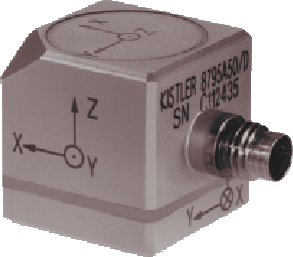
The chosen instrument to measure
vibrations will be a tri-axial accelerometer that will be fixed to the cable
with quick set epoxy. The decision to use this device has been made because of
the durability and compact nature of the device. Although the other devices may
produce a more accurate and precise reading their applications are impractical
due to the fact that the majority of tensile roof cables are at higher
elevations, in horizontal configurations and may be enclosed in an insulating
liner. This would make it impractical to use the latter two because it would be
difficult to get a clear shot of the cables from the ground and may run the risk
of damage to expensive measuring devices. It is also more efficient to have two
technicians perform the entire test in place than to have an additional ground
man operating the measuring instruments.
From the collected data it will
be possible determine the approximate tension found in the cables by
application of the taut string theory and comparing the results to the
predetermined safe working loads determined by the structural engineer.
References cited:
Byeong Hwa Kima, Taehyo Parkb. (2006) Estimation of
cable tension force using the frequency-based system identification method.
Retrieved April 9, 2013 from http://dx.doi.org/10.1016/j.jsv.2007.03.012
Carmelo Gentile. (2009) Deflection measurement on vibrating stay cables by non-contact microwave interferometer. Retrieved April 9, 2013 from http://dx.doi.org/10.1016/j.ndteint.2009.11.007
Hani H. Nassif, Mayrai Gindy, Joe Davis. (2004) Comparison of laser Doppler vibrometer with contact sensors for monitoring bridge deflection and vibration. Retrieved April 9, 2013 from http://dx.doi.org/10.1016/j.ndteint.2004.06.012
Borri, C., Majowieki, M., & Spinelli, P. (1992). Wind response of large tensile structure – The new roof of the Olympic Stadium in Rome. Journal of Wind Engineering and Industrial Aerodynamics, 42(1-3), 1435-1446.
Bridgens, B., & Birchall, M. (2012). Form and function: The
significance of material properties in the design of tensile fabric structures. Engineering
Structures, 44, 1-12. doi: 10.1016/j.engstruct.2012.05.044
Eisenloffel, K., & Adeli, H.(1993). Microcomputer-aided design of
tensile roof stuctures. Computers & Structures, 46(1), 157-174.
Rizzo, F., D’Asdia, P., Lazzari, M., & Procino, L. (2011). Wind
action evaluation on tension roofs of hyperbolic paraboloid shape. Engineering
Structures, 33(2), 445-461. doi: 10.1016/j.engstruct.2010.11.001
Rizzo, F., D'Asdia, P., Ricciardelli, F., & Bartoli, G. (2012).
Characterisation of pressure coefficients on hyperbolic paraboloid roofs. Journal
of Wind Engineering & Industrial Aerodynamics, 102, 61-71. doi:
10.1016/j.jweia.2012.01.003
Szostkiewicz-Chatain, C., & Hamelin, P. (1998). Numerical and
experimental stiffness characterisations applied to soft textile composites for
tensile structures. Materials and Structures, 31(2), 118-125. doi:
10.1007/BF02486474
Anonymous. (2008). Berlin central station, Germany. The
Architectural Review, , 39.
Szostkiewicz-Chatain, C., & Hamelin, P. (1998). Numerical and
experimental stiffness characterisations applied to soft textile composites for
tensile structures. Materials and Structures, 31(206), 118-125.
Wakefield, D. (2006). Tensile structure design an engineer's
perspective. Architectural Design, 76(6), 92-95. doi:
10.1002/ad.370

Laser Doppler vibrometer
(Comparison of laser Doppler vibrometer with contact sensors for monitoring bridge deflection and vibration, 2004, fig. 2)

Microwave interferometer
(Deflection measurement on vibrating stay cables by non-contact microwave interferometer, 2009, fig. 1)


Well written abstract!
ReplyDeleteThe applied nature of the research is a bit unclear. Are you developing a new measurement system, comparing various measurement methods, or are you testing existing structures, or a combination?
As far as I have found there really is no procedure for measuring the tension in cables of tensile roof structures. After the design phase not much is known about their actual values. I am proposing a feasibility study to determine if an already used measuring system can be applied to a new media. This will be done with the small scale test that is outlined in my research proposal. If in fact it is possible to use this method to determine tension in cables of tensile roof structures what will be the quickest and most efficient method of applying this technique to a full scale structure.
ReplyDeleteSo to answer your question I am applying an already used technique to a new media and if small scale tests are successful developing a procedure that can be used on actual structures. The end results of this research will be a service that will be valuable to the owners and managers of these facilities that will help them to better understand the safety and maintenance schedules for their properties.
ReplyDeleteNice blog! Very interesting and informative post….Thank's for sharing such a nice information….Keep it up!!
Gazebo Manufacturers Dehradun
Pagoda in Dehradun
Gazebos in Dehradun
Awnings Canopies Dehradun